

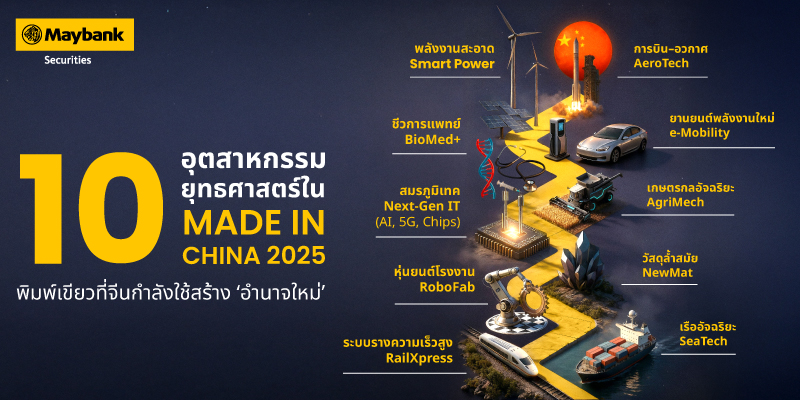
10 Strategic Sectors in Made in China 2025
In the past, China had to face the “high labor cost trap” and rising competition from countries that relied on cheaper labor. The era of easy money from mass manufacturing was no longer a way out.
So, China needed to leap to a higher–value point — not just traditional manufacturing, but industries driven by technology, research & development, and innovation.
In recent years, China no longer wanted to be just the “world’s factory” producing cheap goods for others. Instead, it aimed to transform into an “industrial superpower” that controls both technology and the entire value chain itself.
Made in China 2025 (MIC 2025) was the master plan announced in 2015 (drafted in 2014) to elevate the nation’s industrial capacity and move up the value ladder.
Even though the name Made in China 2025 was later “blurred” in official communications (after facing heavy pushback from abroad), the core principles and policies remain intact,
revived under new frameworks such as “sustainability,” “dual circulation,” and “high-quality development.”
MIC 2025 rests on three pillars:
1.Boosting domestic production of core materials and components (localization)
2.Prioritizing quality, innovation, and green manufacturing
3.Elevating industrial capabilities to compete globally
China has set a clear target: by 2025, at least 70% of core components and key materials that used to rely on imports must be produced domestically. This shows that MIC 2025 is not merely a “mid-term plan,” but rather a blueprint for the century, mapping out how China wants to dominate the global industrial stage.
⚙️ New Materials & Rare Earth
From basic metallurgy, China is moving toward advanced alloys, composites, and high-performance materials that can withstand pressure, tension, and extreme heat.
Strengths: natural rare earth reserves and a strong supply chain advantage
Weaknesses: processing technology and advanced know-how still reliant on imports in some areas
(Companies: China Northern Rare Earth, CNBM, Baowu Steel)
☀️ Smart Power / Renewable & Grid
From a coal-heavy power system, China is transitioning into solar, wind, smart grids, and ultra-high-voltage (UHV) transmission to meet soaring energy demand.
Strengths: ability to mass-produce solar and wind equipment at scale and cost advantage → global market dominance
Weaknesses: grid stability and interconnectivity remain big challenges
(Companies: Sungrow, Goldwind, China XD Electric)
🚀 Aerospace
China used to rely almost entirely on imports for aircraft and key parts. Now it invests heavily in commercial aircraft, engines, and satellites to secure its place in the aviation world.
Strengths: massive state support and long-term R&D investments
Weaknesses: engines and flight control systems remain weak spots compared to Western players
(Companies: COMAC, AVIC)
🚗 e-Mobility
China’s auto industry is shifting from combustion engines to EVs, hybrids, and batteries. It has built a complete ecosystem: from cars (BYD, NIO) to batteries (CATL), which now supply automakers worldwide.
Strengths: the largest domestic EV market, full production infrastructure, and fast learning curve, especially in batteries
Weaknesses: cutthroat competition, price wars, and trade pushback from abroad
(Companies: BYD, CATL, NIO)
🚜 AgriMech (Smart Agriculture)
China is moving away from labor-intensive farming to automation: smart tractors, modern harvesters, and agri-tech solutions to cut costs and deal with an aging workforce.
Strengths: huge domestic demand and strong food security policies driving adoption
Weaknesses: high-end technology still needs upgrading; distribution to rural smallholders remains a challenge
(Companies: YTO Group, Lovol, Zoomlion)
🤖 RoboFab (Industrial Robotics & Precision Machinery)
Factories are shifting from human labor to automation: robotic arms, cobots, and CNC precision machines.
Strengths: strong domestic demand and a rapidly growing supplier ecosystem
Weaknesses: core components like sensors, servos, and high-end software still lag behind
(Companies: Siasun, Estun, Shenyang Machine Tool)
📱 Next-Gen IT (AI, 5G, Chips)
This is the crown jewel of MIC2025 from 5G/6G networks and cloud-AI to semiconductors. Huawei and ZTE lead in telecom equipment, while SMIC pushes forward in foundry manufacturing.
Strengths: massive user base accelerates adoption, robust hardware ecosystem, and consistent R&D investment
Weaknesses: limited access to advanced tech (like lithography machines) due to export restrictions, making advanced node progression difficult
(Companies: Huawei, ZTE, SMIC)
🚄 RailXpress (High-Speed Rail & Smart Rail)
China has built the world’s largest high-speed rail network and developed CRRC into a global supplier of locomotives and rail systems.
Strengths: huge domestic network scale and learning curve advantage, with its own technical standards
Weaknesses: overseas expansion depends on host-country policies, financing, and competition from Japan/Europe
(Companies: CRRC)
🧬 BioMed+ (Biopharma & Medical Devices)
From basic drugs and traditional Chinese medicine, China is pushing advanced pharmaceuticals, vaccines, high-tech medical devices, and CRDMO services.
Strengths: huge domestic healthcare market, rising health budgets, and global “champions” across devices and biotech services
Weaknesses: political and regulatory frictions with the West (e.g., Biosecure Act) may hurt international expansion
(Companies: Mindray, WuXi AppTec, Sinopharm)
🚢 SeaTech (Smart Shipping & Marine Engineering)
China is piecing together “maritime-industrial power” through advanced shipbuilding, LNG carriers, container ships, and offshore platforms. CSSC is a global shipbuilding giant, while CIMC Raffles specializes in offshore engineering.
Strengths: holds the largest share of global shipbuilding orders (by tonnage) and consolidating further for efficiency
Weaknesses: vulnerable to cyclical downturns and foreign trade measures
(Companies: CSSC, CIMC Raffles)
Not every MIC2025 industry is equally successful. Research from Rhodium Group shows that while China has made strong progress in many areas, some industries — like advanced robotics and biotech — still lag behind developed nations with deeper innovation capacity. Still, China continues to push aggressively, fueled by state support.
One of the biggest accelerators? Policy firepower. Subsidies, tax breaks, pilot zones, and government-led expos have given Chinese firms an edge to fight globally.
But the road isn’t smooth. The U.S. views MIC2025 as a tech threat, leading to export controls, sanctions on Chinese firms, and trade barriers. These geopolitical frictions could slow parts of the plan.
For global investors, though, this shift creates opportunities. Heavy investment across these 10 strategic industries doesn’t just benefit Chinese firms — it also lifts the global supply chain. Investors who can ride this wave at the right timing may catch one of the defining business currents of the decade.
At the end of the day, Made in China 2025 isn’t just an economic plan on paper. It’s a power blueprint.
The 10 industries it highlights aren’t just a list — they’re battlegrounds where China seeks to prove its industrial strength to the world.
For investors: don’t just see it as “categories,” see it as a mega-wave of change — full of opportunities and risks that could reshape the global economic landscape in the decades to come.

E-mail Customer Service
mst.clientservice@maybank.com
Call Customer Service
026585050
Line Customer Service
@maybankfriendsContact us


